For the Record.
Can I Keep Copies of My Performance Reviews?
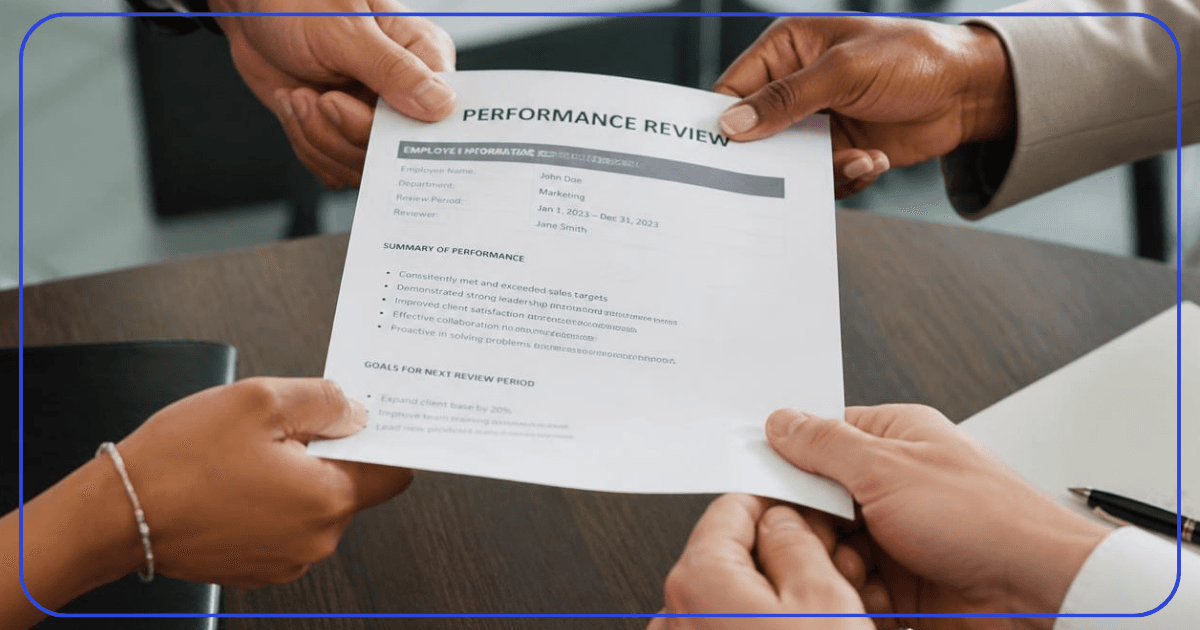
In most situations, yes. A performance review that was delivered to you, that you were asked to read, and that you were asked to sign is a document about you that you participated in. Keeping a personal copy of it is ordinary and defensible.
The complications start when people go further than that, so let us separate what is safe from what is not.
Start with your handbook
Before anything else, read your employer's policies on confidential information, document retention, and use of personal devices or personal email. Most handbooks address this directly. Some employers explicitly allow you to keep copies of your own personnel documents. Some restrict forwarding anything to a personal account. Some say nothing at all.
Knowing what your specific employer says is worth more than any general rule, because the general rule is that it depends.
Getting a copy in the first place
Whether your employer has to hand over your personnel file, or let you inspect it, varies quite a bit depending on where you work. Some states give private sector employees a right to inspect or copy their own personnel records, sometimes with time limits and sometimes with a fee. Other states give no such right to private sector employees at all, and public sector rules are often different from private sector rules in the same state.
So the honest answer is: check the law where you work, and check your handbook, because the two together decide what you are entitled to demand.
What you do not need permission for is far simpler. If a manager hands you a review, emails you a review, or sits you down and asks you to sign a review, you can generally take note of it. Ask for a copy on the spot. Most of the time you will just be handed one. The awkward moment of asking is much smaller than the awkward moment of needing it a year later and having nothing.
What you should not take
This is the part that damages people, and it usually happens with good intentions.
Do not bulk download. Pulling large volumes of company files onto a personal drive, especially close to a resignation or a termination, looks like theft even when you meant to protect yourself. It shifts the conversation from what your employer did to what you did, and that is a terrible trade.
Do not take other people's information. Another employee's review, medical information, salary data, or complaint file is not yours to hold, no matter how much it supports your point. Taking it can create real problems for you and real harm for them.
Do not take trade secrets or proprietary material. Client lists, source code, pricing models, formulas, unreleased product plans. If you signed a confidentiality agreement, read it. The fact that a document also happens to mention you does not turn a protected business record into a personal one.
Do not go looking through systems you are not supposed to access. Curiosity is not authorization.
The rule of thumb: keep documents that were given to you, about you. Be very careful with everything else.
When you cannot keep the document
Sometimes the review is on a screen and you are not getting a copy. Sometimes the system logs you out the moment the meeting ends. Sometimes you ask and are told no.
You can still preserve the substance. What you cannot keep, you can record.
Write down the same day:
- The date of the review and the review period it covered
- Your overall rating or score, in the exact terms used
- Every specific criticism, and the language used to describe it
- Every specific piece of praise, in the same detail
- Whether numbers or metrics were cited, and what they were
- Who conducted the review, and who else was present
- What you said in response
- What was promised: a raise, a plan, a follow up, a reconsideration
- Whether you were asked to sign, and whether you did
That record is not the document, but it is dated, specific, and made while the details were fresh. That counts for a great deal more than a memory reconstructed under pressure two years later.
Why old reviews matter later
A stack of solid reviews is quietly one of the most useful things you can hold.
Reviews establish the baseline. If four years of reviews describe you as reliable and detail oriented, and then two months after you raise a concern the story becomes that you have always been careless, the reviews are what make that shift visible. Not your feelings about it. The documents.
Reviews also expose timing. When performance suddenly becomes a problem, the date the story changed is often the most important date in the whole picture. You can only see it if you have what came before.
And reviews protect against convenient revision. A written record from 2023 cannot be adjusted in 2026 to fit a new narrative.
Store them somewhere that survives your badge
Here is where people lose everything they carefully collected.
They save reviews to their work laptop. They keep them in a folder in their work email. They leave them in the company HR portal, assuming it will always be there.
Then access ends, on a random morning, with no warning. The laptop goes back. The email is cut. The portal login stops working. Every document that mattered was on the other side of a door that just locked.
Whatever you keep, keep it somewhere your employer cannot reach and cannot revoke.
A CFile is built for exactly that. Your CFile Log runs alongside a job, holding what you record as you record it, dated and delivered to your own inbox. Reviews, meetings, promises, changes. If a pattern develops, the related entries gather into a Minifile so the arc is visible instead of scattered.
HR keeps a file on you. Keep one on yourself.
This article is general information about documentation practices, not legal advice, and it does not create an attorney client relationship. Laws about access to personnel records vary by state and by employer type.